Sunday, February 15, 2026


🔬 Mapping the Landscape of FDA-Approved Anti-Neoplastic Small Molecules

Over the past weeks, I’ve been curating and structuring a dataset of FDA-approved anti-neoplastic small molecules, starting from standardized SMILES and integrating approval metadata, physicochemical descriptors, and structural biology annotations (initially sourced from ChEMBL).

The aim was not simply to compile a list —
but to transform it into an explorable chemical and structural landscape.


🧬 1️⃣ Structural Overview

A visual library of FDA-approved anti-neoplastic small molecules with approval year annotations.
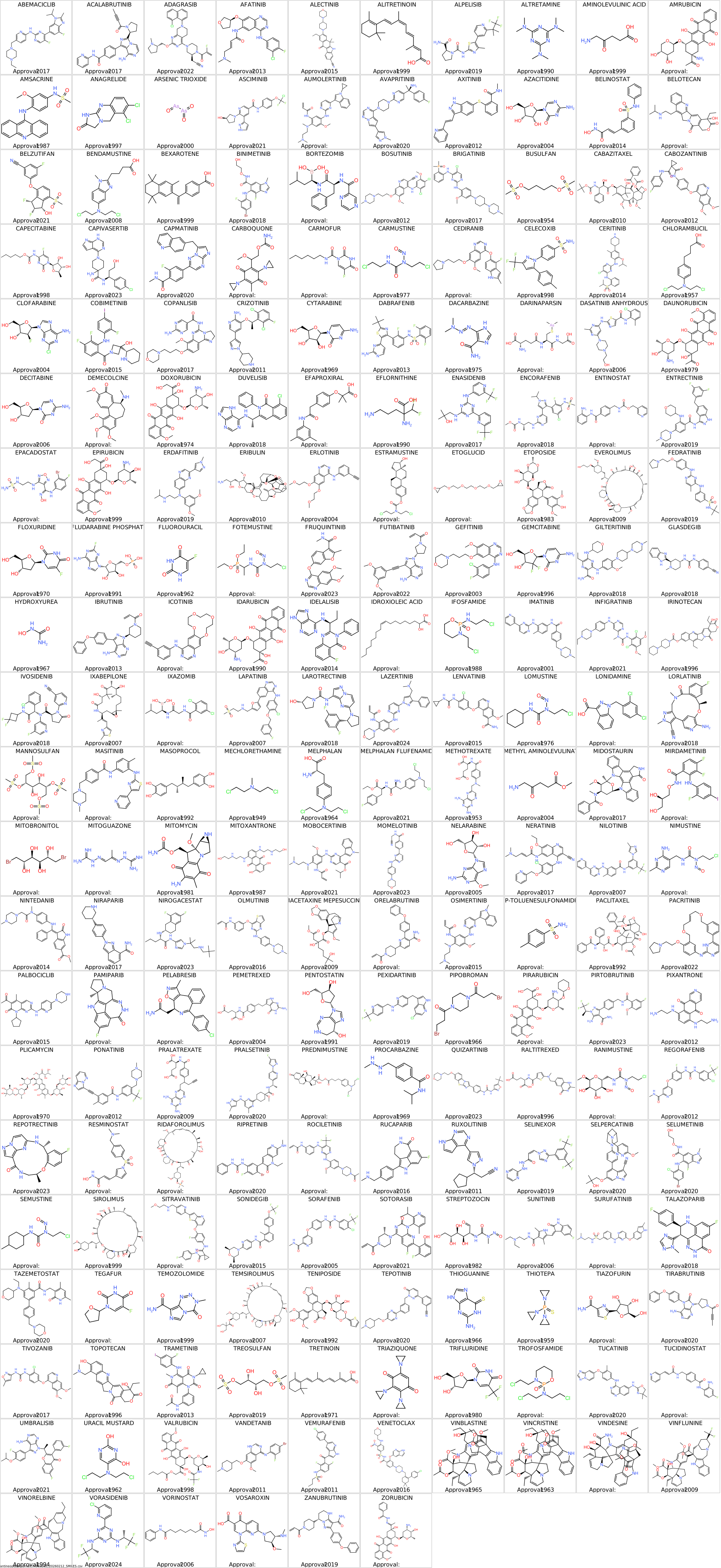
Even visually, you can observe:

  • The transition from classic cytotoxic scaffolds

  • The rise of kinase inhibitors

  • Increasing molecular complexity over decades

  • The appearance of macrocycles and larger architectures

This reflects the broader evolution of oncology drug design.


📊 2️⃣ Physicochemical Space


Plotting Molecular Weight vs cLogP reveals:

  • Clear clustering of targeted therapies

  • Highly polar nucleoside analogues

  • Large macrocyclic outliers

  • Expansion of “drug-like” space over time

This helps contextualize how medicinal chemistry strategies have shifted historically.

This creates a "3-dimensional (parameters) representation" in a single 2D view.


📈 3️⃣ Multi-Dimensional Structural Biology View


Using DataWarrior, I generated a 3D landscape including:

  • Molecular Weight

  • Number of UniProt-associated targets

  • Number of available PDB structures

  • Color-coded by approval year

  • Marker size reflecting ring count

This creates a 5-dimensional representation in a single interactive view.

An important nuance:

A higher number of UniProt entries does not automatically imply promiscuity.
It may reflect:

  • Cross-species target annotation

  • Extensive structural biology investigation

  • Historical research intensity

  • Drug repurposing efforts

A natural next step would be to analyze:

• Are these targets orthologous across organisms?
• Do some drugs truly exhibit multi-target pharmacology?
• Can we disentangle biological promiscuity from research bias?

This is where the dataset becomes biologically interesting — not just chemically descriptive.


Why this matters

Understanding oncology drug evolution across structure, physicochemistry, and target space can support:

  • Docking benchmark construction

  • Selectivity modeling

  • ML feature generation

  • Target network analysis

  • Drug evolution quantification

This is a foundation toward a structured, ML-ready oncology drug landscape.


Questions for the Community

I would greatly appreciate your perspective:

• Are there curated FDA oncology drug lists beyond ChEMBL that you recommend?
(e.g., ChemOncology, DrugBank, FDA Orange Book integrations, others?)

• Would integrating binding affinity data meaningfully improve this landscape?

• Should cross-species target mapping be separated from true multi-target pharmacology?

• Are there structural biology metrics that would add value here?

• What additional dimensions would you want visualized?

I’m especially interested in perspectives that connect structural biology, medicinal chemistry, and computational modeling.


More to come as this evolves.

Evangelos Papadopoulos
Computational Structural Biology | Drug Discovery | Molecular Modeling

Saturday, October 4, 2025

🚀 Scaling Drug Discovery with High-Throughput Docking.

https://www.linkedin.com/feed/update/urn:li:ugcPost:7380434370551234560/


What kind of questions would you like to ask?


Over the past months at Dana-Farber, I’ve been working on large-scale docking pipelines that screen hundreds of thousands of compounds against protein pockets relevant to multiple myeloma and other cancers.


This work relies heavily on:
• HPC clusters with hundreds of nodes running in parallel
• Automation with bash, Python, and GNU Parallel
• Data wrangling across millions of output files


As the datasets grow, interesting questions emerge:

⏱️ How does docking time scale per compound with protein size and degrees of rotational freedom?
📊 How do docking box volumes (ų) correlate with energy distributions?
⚖️ What are the trade-offs between exhaustiveness, accuracy, and throughput?


I’ve been generating statistics and visualizations (histograms, distributions of binding energies, runtime analyses per protein/compound), and it’s exciting to see patterns begin to form.


👉 I’m curious: for those of you working in computational biology, cheminformatics, or HPC. What kinds of metrics or analyses do you find most valuable when scaling docking to this level?


Monday, August 18, 2025


🔬 Proud Dad — and Fellow Scientist Moment 🌟

This summer, my son Gerasimos (15) joined me at the Dana-Farber Cancer Institute as an intern in our research lab. He explored the world of molecular biology, microscopy, protein analysis, and experimental design — not as a visitor, but as a real participant.

It’s deeply moving to see your child walk into a space where you’ve worked for years and begin to grow into his own path — asking questions, pipetting samples, reading results, presenting findings. I’m proud not only of what he learned, but how he approached the lab: with respect, focus, and curiosity.

🔗 Sharing a few moments from this experience, in hopes that more young people get inspired to discover the beauty of science and research early on.

#STEMEducation #DanaFarber #NextGenScience #Mentorship #FatherAndSon #BiomedicalResearch #InternshipExperience


Internship 2025

Tuesday, July 1, 2025

🧬 New Structure Gallery Added: eIF4E–4EGI1 Complex (PDB 4TPW)

I’ve added a new interactive visualization page for the published protein structure 4TPW, showcasing the eIF4E cap-binding protein in complex with the small-molecule inhibitor 4EGI‑1.

This allosteric complex disrupts eIF4E’s interaction with eIF4G, highlighting a therapeutic mechanism in cancer-related translation initiation. The ligand structure and binding mode are displayed with clarity using an embedded 3D viewer.

🔗 Explore the interactive structure here:
https://evanspap.github.io/Published_Structures/4TPW.html

💬 Also shared on LinkedIn:
https://www.linkedin.com/feed/update/urn:li:share:7346026484299436032/

Feel free to explore and let me know your thoughts or suggestions for future structural uploads!

#StructuralBiology #ProteinStructures #DrugDiscovery #eIF4E #4EGI1 #NGLviewer #CancerResearch #OpenScience

Tuesday, May 6, 2025

BMI Calculator

BMI Calculator

BMI Calculator


Interpretation Guide:
BMI < 20: severely underweight
BMI = 25: ideal weight
BMI = 30: maximum healthy weight
BMI > 35: severely overweight

These are guidelines and
should not be considered as
universally applied to all individuals.

Monday, April 21, 2025

The Joyful Journey in Protein Sciences

The Joyful Journey in Protein Sciences

🧬✨ The Joyful Journey in Protein Sciences

A Lifelong Passion from Teenage Curiosity to Professional Discovery


lab

🧪🔬 Working in a laboratory has always been a passion of mine, so deep-rooted that even as a teenager, I would collect my little pocket money allowance from my parents and hop on the metro to downtown Athens. My goal? To find new lab equipment or exciting chemicals to bring back home to our basement, which had become my personal little laboratory. I conducted experiments purely for the joy of discovery and learning. Those days fill me with nostalgia and great emotion, recalling the immense joy and satisfaction I felt. The shopkeepers in Athens even came to know me well, anticipating my weekly visits. On my last visit before heading to university, they warmly congratulated me, assuring me they knew I would someday become a fine research scientist—perhaps even a professor. Every day that I step into the lab now, it feels like a direct continuation of that youthful enthusiasm.

Seeing those first protein crystals under a microscope is a moment of pure joy and awe. It symbolizes not only the success of my careful planning and labor but also the gateway to understanding proteins at the molecular level. 

Using the correct crystal plates is crucial. Each well-designed crystal plate contributes significantly to successful crystallization. Having proper plates enhances the probability of forming high-quality crystals, crucial for downstream X-ray crystallography studies. It's fascinating how such detailed considerations impact the ultimate scientific discoveries we pursue.

Beyond just growing the crystals, my passion extends to solving their structures. Whether crystallizing proteins alone, in complexes, or even with a potential drug compound, the thrill of solving a protein structure never fades. From the initial stages of molecular biology, cloning, and bacterial culture, through protein purification and crystal growth, to finally collecting X-ray diffraction data and interpreting the electron density maps, every step holds excitement and anticipation.

Yet my passion in protein sciences extends beyond crystallization. I've been equally fascinated by liquid-state Nuclear Magnetic Resonance (NMR) spectroscopy, computational protein analysis, and diverse protein assays, all offering unique insights into protein structure and function.


I vividly remember how capturing and documenting these precious moments in research have evolved over time. In the past, we relied heavily on film scanners to document our findings—a process that was often slow and cumbersome. Nowadays, the convenience of mobile phone cameras allows immediate uploading of images to cloud storage, facilitating instant access and collaboration with colleagues worldwide. This technological advancement has significantly streamlined our work.

Innovation and creativity are also essential in protein sciences. At times, we must design and improvise new devices, such as custom purification columns or specialized stands, to tackle experimental challenges effectively. Every such innovative approach enriches our research capabilities and opens new doors for discovery.

From molecular biology techniques like cloning and bacterial transformation to protein purification, assays, and advanced computational analyses, every step is fascinating and contributes meaningfully to our understanding. Ultimately, whether crystallizing proteins alone, in complexes, or with potential drug compounds, or analyzing proteins through NMR and computational methods, each step of the scientific journey is filled with excitement and anticipation.


In short, working in protein sciences is a delightful blend of meticulous techniques, evolving technology, innovation, and persistent curiosity—an endlessly rewarding journey through discovery. 😊✨


Tuesday, April 1, 2025

Nobel Prize Award Ceremony & Stockholm University

Nobel Ceremony Venue and Stockholm University Visit, January 2025

🌟 Memories from Stockholm and the Nobel Prize Ceremony 🌟

Arlanda_Train

   Reflecting on my recent visit to Stockholm has been a deeply emotional and meaningful experience. Returning to the iconic Konserthuset at Hötorget, where the Nobel Prize ceremony is held every December, brought back a flood of memories. It was a poignant moment to walk through those familiar halls, reminiscent of the time I attended the Nobel ceremony in 2003 with my parents. The ceremony's invitations, schedule, and speeches from that day still hold a special place in my heart.

alt_text alt_text

alt_text

   One of the highlights of this visit was reuniting with my former PhD supervisor, Professor Astrid Gräslund, who served as the secretary of the Nobel Prize Committee for Chemistry. Meeting her again after a decade evoked memories of her invaluable mentorship and the guidance she provided during my research journey.

alt_text alt_text

   Visiting the Svante Arrhenius Laboratory at Stockholm University was another significant moment. This laboratory was my academic home for eight transformative years, where I engaged in impactful research, expanded my knowledge, and forged enduring relationships. Standing before the statue of Svante Arrhenius, whose work had inspired me since my high school days, was a surreal and gratifying experience.

alt_text alt_text

   This trip wasn't just a nostalgic journey—it rekindled deep emotions, gratitude, and a profound appreciation for the enduring connections that have shaped my life. I am thankful for these experiences and inspired by the cyclical nature of life, where past and present intertwine to create a tapestry of memories and growth.

alt_text